Posts

Streamlining Data Integration with ETL in AWS: A Comprehensive Guide
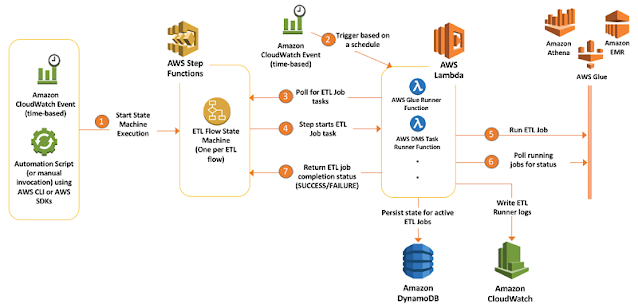
Image
Introduction: In today's data-driven world, organizations need efficient and reliable methods to integrate and transform their data. ETL (Extract, Transform, Load) plays a vital role in this process, enabling businesses to extract data from various sources, transform it into a usable format, and load it into a target destination. AWS (Amazon Web Services) offers a robust ETL solution, empowering organizations to seamlessly integrate and manage their data. In this article, we'll explore the benefits and best practices of ETL in AWS . What is ETL in AWS? ETL in AWS refers to the process of extracting data from different sources, transforming it into a consistent format, and loading it into AWS data services or other target destinations for analysis, reporting, or storage. AWS provides a suite of services, such as AWS Glue, AWS Data Pipeline, and AWS Database Migration Service (DMS), that simplify and automate the ETL process. Benefits of ETL in AWS: Scalability: AWS off...

A Comprehensive Guide to AWS ETL Options for Efficient Data Management

Image
 Introduction: AWS ETL (Extract, Transform, and Load) options are a set of services and tools offered by Amazon Web Services (AWS) to help businesses manage and move data between various data sources and destinations. These tools are designed to simplify the process of extracting data from different sources, transforming it into a suitable format, and then loading it into a target data store or analytics platform. In this article, we will explore some of the popular AWS ETL options and their features. AWS Glue: AWS Glue is a fully-managed ETL service that makes it easy to move data between various data stores. It can crawl data sources, automatically generate ETL code, and load the transformed data into target data stores or data warehouses. AWS Glue supports a wide range of data sources including Amazon S3, Amazon RDS, and Amazon Redshift, and allows users to run ETL jobs on a schedule or on-demand. It also integrates with AWS Lambda, enabling users to perform custom transfo...

How to Replicate Oracle Data to SQL Server

Image
Replicating data from Oracle to SQL Server can be a challenging task, especially if you're dealing with a large and complex database. However, with the right tools and strategies, you can ensure a smooth and efficient replication process. This article outlines the steps you need to follow to Oracle replication to SQL server Step 1: Choose the Right Replication Tool There are several replication tools available for migrating data from Oracle to SQL Server. Some popular options include Oracle GoldenGate, SQL Server Integration Services (SSIS), and Attunity Replicate. Each tool has its own strengths and weaknesses, so it's important to choose the one that best fits your requirements and budget.   Step 2: Configure Oracle as the Source Database   Once you have selected your replication tool, you need to configure Oracle as the source database. This involves creating a user account with sufficient privileges to access and replicate the data. You also need to specify the tab...

An Overview of AWS ETL Tools and How to Choose the Right One

Image
Extract, Transform, Load (ETL) is an essential process for any organization that deals with large volumes of data. AWS offers a range of ETL tools that can help you extract data from various sources, transform it, and load it into AWS services for analysis and storage. In this article, we'll provide an overview of AWS ETL tool and how to choose the right one for your needs. AWS Glue is a fully managed ETL service that enables you to extract data from various sources, including Amazon S3, JDBC, and Amazon RDS. It also provides a visual editor for creating ETL jobs and a built-in Apache Spark engine for data processing. With Glue, you can transform and load data into Amazon Redshift, Amazon EMR, and other AWS services. AWS Data Pipeline is another ETL service that enables you to move and transform data across AWS services and on-premises environments. It supports various data sources and destinations, including Amazon S3, DynamoDB, RDS, and Redshift. Data Pipeline also provides ...

The Functioning of AWS DMS Services

Image
AWS DMS (Amazon Web Service Database Migration Service) is based in the cloud and facilitates the migration of databases between data warehouses, relational databases, and NoSQL and relational databases. While migrating with AWS DMS services , ensure that at least one of the source and the target databases is in the cloud. Functioning of AWS DMS Services There are three ways that AWS DMS services function for database migration. ü Full-load database migration: Both the source and the target database are shut down and the database is migrated from the source to the target in one shot. ü Ongoing database migration: The source and the target databases are always kept in sync and after the full data migration is completed, changes at the source or incremental data are migrated to the target at pre-set intervals. ü Change Data Capture: Only the changes to the data at the source are migrated to the target database. Businesses need to choose the right AWS DMS services that ...

What is the ETL Tool of Amazon Web Service

Image
AWS (Amazon Web Service) is a platform that is based in the cloud and offers several cutting-edge services. These include infrastructure as a service, platform as a service, and packaged software as a service. Among the other key services are facilitating database migration from on-premises systems to the cloud, one cloud provider to another, relational databases, data warehouses, and NoSQL databases. To carry out this activity, the most efficient resource is the ETL tool for AWS . Before going into the various benefits of using the ETL tool for AWS, it is necessary to understand how this Extract, Transform, Load (ETL) process works. There are three stages here. First, the ETL tool extracts data from the source database, then transforms it to a structure that matches one that is supported by the target database, and finally, loads the processed data into the intended database.   Click here for more information about the ETL tool for AWS. Benefits of Using the ETL Tool for ...

Why Should You Migrate Databases Using Amazon DMS

Image
Businesses today look to migrate databases to high-efficient cloud-based platforms to increase operational efficiencies. One way is to move to Amazon Web Services (AWS) using their Database Migration Service (DMS). During migration with Amazon DMS , the source database remains fully functional and there is no need for downtime, a boost for large organizations as shutting down systems affects their operating schedules. Amazon DMS for database migration is perfect for both Homogeneous Migration such as Oracle to Oracle and Heterogeneous migration like Microsoft SQL Server or Oracle to Amazon Aurora. It can also replicate data continuously for consolidating databases into a data warehouse with petabyte-volume data streamed to Amazon S3 and Amazon Redshift. Click here for information about Amazon DMS Why should you migrate databases using Amazon DMS? With Amazon DMS, there is no need to install and configure additional drivers and applications for database migration as the same is...